Thursday, April 11, 2019

David P. Mastagni Commended for 45 years Devotion to Public Safety Professionals

March 30th, 2019 Assembly Member Honorable Jim Cooper of the 9th District introduced a resolution to the legislature to commend David P. Mastagni and the Mastagni Holstedt Law Firm for 45 years of service and devotion to protecting the rights of public safety professionals including Law Enforcement, Firefighters, and First Responders throughout the State of California.

Click Here to View Full Size Document


California Globe Article on AB 392 Featuring Kathleen Mastagni Storm Taking the Fight to Them

The California Globe highlights Kathleen Mastagni Storm's testimony on AB 392 in the article linked below:

Police Use of Force Bill is ‘Epitome of Second Guessing’ by Lawmakers
https://californiaglobe.com/legislature/police-use-of-force-bill-is-epitome-of-second-guessing-by-lawmakers/

Tuesday, April 9, 2019

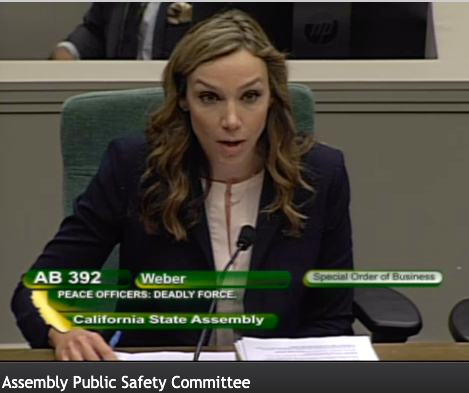
WATCH NOW: Kathleen Mastagni Storm Testifies Before the California Assembly Public Safety Committee In Opposition to AB 392


Today, in powerful testimony before the Public Safety Committee, Kathleen Mastagni Storm urged members of the committee to vote no on AB 392. As outlined in her testimony, AB 392 would criminalize police use of force and incentivize disengagement through prosecution of officers.


Below, watch the opposition tesimony of Shane LaVigne of Capitol Advocacy, Deputy Sheriff Julie Robertson, and Kathleen Mastagni Storm.


Wednesday, April 3, 2019

New 2nd Amendment Ruling Invoking Right of Self-Defense Illustrates Unconstitutionality of AB 392

On March 29, 2019, federal Judge Roger Benitez issued a permanent injunction invalidating a California law (Penal Code Section 32310) mandating the confiscation of high capacity magazines, i.e. magazines holding more than 10 rounds.  The broader ramifications of Judge Benitez' ruling spotlight the unconstitutionality of A.B. 392 in severely restricting peace officer self-defense rights, as well as violating equal protection by subjecting officers to second class constitutional rights.

Following U.S. Supreme Court precedent, the Ninth Circuit has already recognized, “Central to the rights guaranteed by the Second Amendment is “the inherent right of self-defense.”  United States v. Torres (9th Cir. 2019) 911 F.3d 1253, 1257 (citing, District of Columbia v. Heller, 554 U.S. 570, 628, 128 S.Ct. 2783, 171 L.Ed.2d 637 (2008).  The Ninth Circuit recognized, the “core” of the Second Amendment right “is the right of self-defense by ‘law-abiding, responsible citizens.’” Id.  

In holding the magazine ban violated the Constitutional right to “keep and bear arms”, Judge Benitez explained our inherent right of self-defense under the U.S. Constitution and that "for laws that do impair self-defense, strict scrutiny" is applicable.  "A law that imposes such a severe restriction on the fundamental right of self-defense of the home that it amounts to a destruction of the Second Amendment right is unconstitutional under any level of scrutiny." Duncan v. Becerra (S.D. Cal., Mar. 29, 2019, No. 3:17CV1017-BEN (JLB)) 2019 WL 1434588, at *10 (citing, Silvester v. Harris, 843 F.3d 816, 821 (9th Cir. 2016)).


Judge Benitez ultimately concluded, “California’s law prohibiting acquisition and possession of magazines able to hold any more than 10 rounds places a severe restriction on the core right of self-defense of the home such that it amounts to a destruction of the right and is unconstitutional under any level of scrutiny.” A.B. 392 imposes far more severe impairments on officers' right of self-defense in several important respects.  First, if officers attempt to detain or arrest the wrong person by mistake, they are stripped of their right of self-defense if that person attempts to kill or injure the officer (under this scenario an otherwise justified use of deadly force constitutes manslaughter).  Officers are also stripped of their right not to retreat in the face of resistance or threat posed by a suspect to themselves or others. 

Most significantly, officers are subjected to a watered down right of self-defense by requiring them to utilize the least intrusive means of self-dense rather than objectively reasonable means based upon the totality of the circumstances.  Officers will be stripped of their right to self-defense and subject to criminal jeopardy any time a critic can conjure up an alternative to force.  For example, if a suspect three feet away draws and aims a handgun at an officer, it will take the officer about 1.5 seconds to perceive this threat, decide to draw his or her gun, and shoot at the suspect. Nearly everyone would agree the officer’s decision was an objectively reasonable use of deadly force. However, under A.B. 392 that officer’s right of self-defense would hinge on the “reasonableness” of the officer’s alternatives, such as the use of a gun take-away technique or quickly advancing on the suspect and knocking him off balance and taking him to the ground. 

Our Ninth Circuit has already rejected the premise of A.B. 392. "Requiring officers to find and choose the least intrusive alternative would require them to exercise superhuman judgment.” (Scott v. Henrich (9th Cir. 1994) 39 F.3d 912, 915.) The appellate court explained further:

“In the heat of battle with lives potentially in the balance, an officer would not be able to rely on training and common sense to decide what would best accomplish his mission. Instead, he would need to ascertain the least intrusive alternative (an inherently subjective determination) and choose that option and that option only. Imposing such a requirement would inevitably induce tentativeness by officers, and thus deter police from protecting the public and themselves. It would also entangle the courts in endless second-guessing of police decisions made under stress and subject to the exigencies of the moment.” Id.

This new Second Amendment case highlights the unconstitutionality of A.B. 392.  The last time the U.S. Supreme Court addressed the Second Amendment, it explained, "self-defense is a basic right, recognized by many legal systems from ancient times to the present, and the Heller Court held that individual self-defense is 'the central component' of the Second Amendment right." McDonald v. City of Chicago, Ill. (2010) 561 U.S. 742.  On the horizon, the U.S. Supreme Court recently granted review in a case involving a New York City law that limits residents from transporting their guns outside their homes and is widely expected to invalidate this law and further expand recognized self-defense rights outside the home.

It should also be noted that the California Constitution provides a similar, if not stronger, express right of self-defense in Article I, Section 1.  (see, People v. McDonnell (1917) 32 Cal.App. 694 (recognizing, that "[t]he right to defend life is one of the inalienable rights guaranteed by the constitution of the state.”)


Wednesday, March 27, 2019

Assembly Member McCarty Introduces New Use of Force Legislation

  
In addition to co-sponsoring A.B. 392, Assembly Member Kevin McCarty recently introduced A.B. 855 to require the Attorney General to promulgate a model use of force policy for law enforcement agencies by 2021 and provide an individualized review of any agency's use of force policy upon request after 2021.

Specifically, his sparse bill would require the Attorney General to convene a task force within the Civil Rights Enforcement Section of the Department of Justice to study officer-involved shootings throughout the state and to develop policy recommendations and a model written policy or general order for the use of deadly force by law enforcement officers, with the goal of promulgating best practices and reducing the number of deadly force incidents that are unjustified, unnecessary, or preventable.  The bill, which can be read here, appears to be modeled after the review the Attorney General conducted for the Sacramento Police Department. 

In contrast to the delayed impacts of A.B. 855, PORAC and other law enforcement groups have sponsored S.B. 230, which will immediately establish a uniform set of use-of-force best practices and mandate every California law enforcement agency to enact them.  S.B. 230 will help achieve better outcomes for everybody, including law enforcement, by providing officers clear guidelines and training on the circumstances when deadly force is authorized, utilizing de-escalation tactics, considering reasonably available alternatives to deadly force, proportionality, rendering medical aid, interceding to prevent excessive use of force, securing medical assistance, interacting with vulnerable populations, reporting requirements, and tactics. 

A.B. 855, like A.B. 392, appears to be predicated on the false assertion that police can currently use deadly force under circumstances where deadly force is not necessary.  Deadly force has always been judged under a necessary standard.  The difference is whether necessity is judged by the totality of the circumstances or redefined as the least possible amount of force. The latter is an inherently subjective inquiry that opens an officers’ split-second decision making in a life or death situation to second guessing as to whether there was a lesser level of force available to them.  Under A.B. 392 officers would be stripped of their constitutional right to self-defense anytime a critic can conjure up an alternative course of action, such as simply retreating. (See Art. I, Sect. 1, California Constitution.)  In fact, our Ninth Circuit expressly repudiated such a standard as unconstitutional, stating “(r)equiring officers to find and choose the least intrusive alternative would require them to exercise superhuman judgment.” (Scott v. Henrich (9th Cir. 1994) 39 F.3d 912, 915.)